
现行监管模式下江苏省某市中医备案诊所监管供需双方效果研究
首发时间:2026-09-11
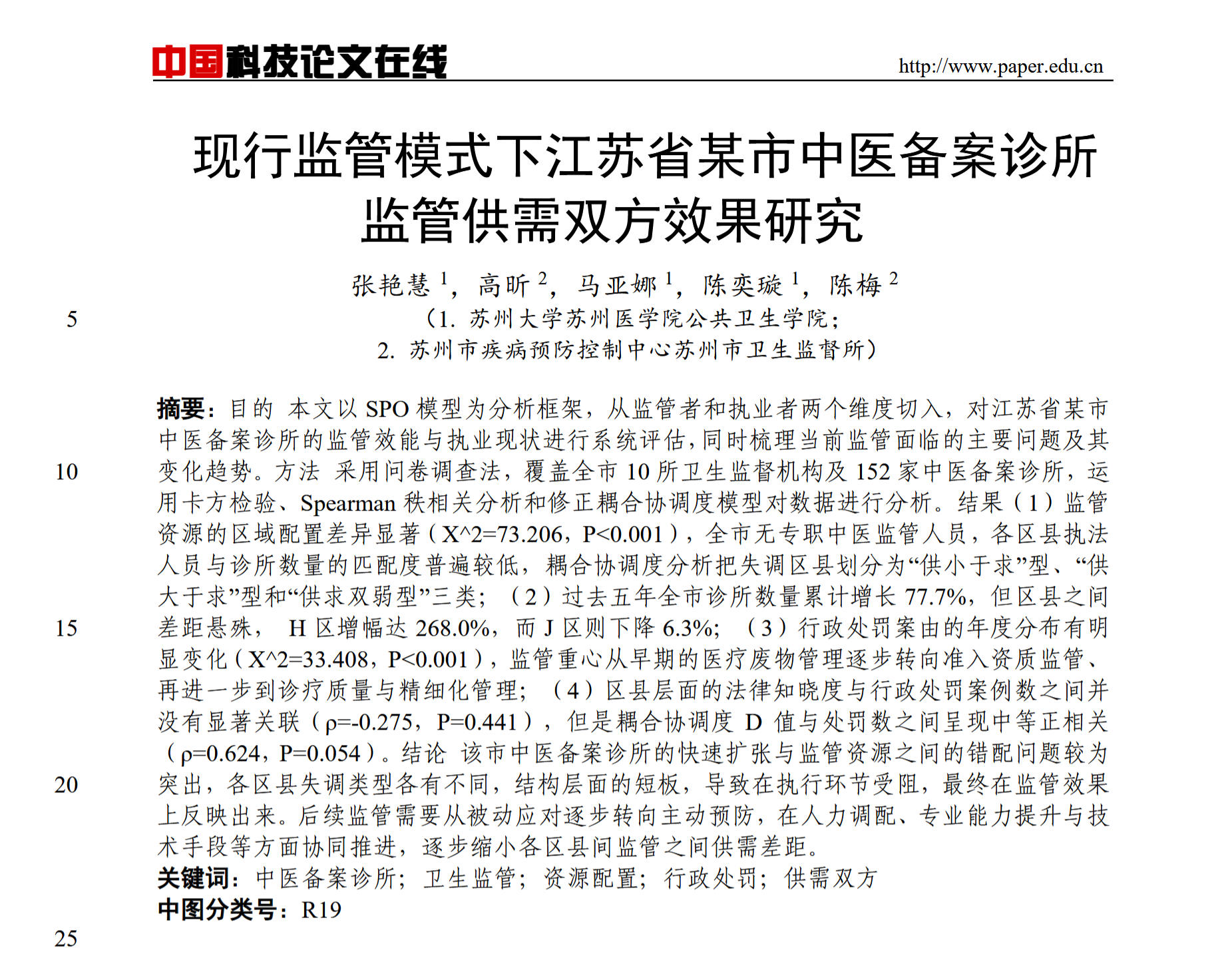
摘要:目的本文以SPO模型为分析框架,从监管者和执业者两个维度切入,对江苏省某市中医备案诊所的监管效能与执业现状进行系统评估,同时梳理当前监管面临的主要问题及其变化趋势。方法采用问卷调查法,覆盖全市10所卫生监督机构及152家中医备案诊所,运用卡方检验、Spearman秩相关分析和修正耦合协调度模型对数据进行分析。结果(1)监管资源的区域配置差异显著(X^2=73.206,P<0.001),全市无专职中医监管人员,各区县执法人员与诊所数量的匹配度普遍较低,耦合协调度分析把失调区县划分为"供小于求"型、"供大于求"型和"供求双弱型"三类;(2)过去五年全市诊所数量累计增长77.7%,但区县之间差距悬殊, H区增幅达268.0%,而J区则下降6.3%;(3)行政处罚案由的年度分布有明显变化(X^2=33.408,P<0.001),监管重心从早期的医疗废物管理逐步转向准入资质监管、再进一步到诊疗质量与精细化管理;(4)区县层面的法律知晓度与行政处罚案例数之间并没有显著关联(ρ=-0.275,P=0.441),但是耦合协调度D值与处罚数之间呈现中等正相关(ρ=0.624,P=0.054)。结论该市中医备案诊所的快速扩张与监管资源之间的错配问题较为突出,各区县失调类型各有不同,结构层面的短板,导致在执行环节受阻,最终在监管效果上反映出来。后续监管需要从被动应对逐步转向主动预防,在人力调配、专业能力提升与技术手段等方面协同推进,逐步缩小各区县间监管之间供需差距。
关键词: 中医备案诊所 卫生监管 资源配置 行政处罚 供需双方
For information in English, please click here
A Study on the Effects of the Current Regulatory Model on Both Supply and Demand Sides of Traditional Chinese Medicine Record-filing Clinics in a City of Jiangsu Province.
Abstract:Objective This paper takes the SPO model as its analytical framework and approaches the issue from two angles-regulatory authorities and clinic practitioners. The aim is to assess how well the regulatory system is functioning in relation to record-filing TCM clinics in a prefecture-level city of Jiangsu Province, what the current state of practice looks like, and what the main problems are and how they have been shifting over time. Methods A questionnaire survey was administered across all 10 health inspection agencies in the city, along with 152 record-filing TCM clinics. For data analysis, we drew on chi-square tests, Spearman\'s rank correlation, and a modified coupled coordination degree model. Results (1) The results brought a few things to light. One is the notable spatial imbalance in regulatory resource allocation (X^2=73.206,P<0.001). There are no full-time TCM-specific inspector positions anywhere in the city, and the fit between inspector numbers and clinic counts across districts is generally weak. The coupled coordination analysis further grouped the unbalanced districts into three types: those where supply falls short of demand, those where supply exceeds demand, and those where both sides are weak. (2) Second, over the past five years the city\'s total clinic count rose by 77.7%, but the growth rates varied widely-one district surged by 268.0%, while another shrank by 6.3%. (3) Third, the composition of administrative penalty categories changed considerably from year to year (X^2=33.408,P<0.001), with regulatory attention moving progressively from medical waste management to entry qualifications, and then further on to treatment quality and more fine-tuned oversight. (4) Fourth, at the district level, legal awareness showed no clear link with the number of penalty cases (ρ=-0.275,P=0.441), though the coupling coordination degree D did show a moderate positive correlation with penalty counts (ρ=0.624,P=0.054). Conclusion The rapid growth in the number of record-filing TCM clinics and the mismatch in regulatory resources are difficult to ignore. How that mismatch manifests itself differs considerably from one district to another. What we see here, in effect, is a chain-structural deficiencies feed into procedural obstacles, and those in turn translate into constrained outcomes. Going forward, there is a case for moving away from reactive enforcement and toward more proactive forms of intervention. This would entail, among other things, adjustments in staffing, investments in professional development, and the adoption of more sophisticated regulatory instruments, all with a view to narrowing the gap between supply and demand across districts.
Keywords: Traditional Chinese Medicine clinics Regulatory enforcement Resource allocation Administrative penalties supply and demand sides
论文图表:
引用


No.****
动态公开评议
共计0人参与
勘误表
现行监管模式下江苏省某市中医备案诊所监管供需双方效果研究
中国科技论文在线 版权所有
网站地图|
在线首页|
在线简介|
服务条款|
联系我们

京公网安备 11040202430024号 京ICP备15006316号-2| 网络出版服务许可证 (总)网出证(京)字第083号 | 文保网安备案号:1101080066
 提示


 .txt
 .ris
 .doc
评论
全部评论