
领域问答中理解式模型的精度等价性与输出模态优势
首发时间:2026-10-22
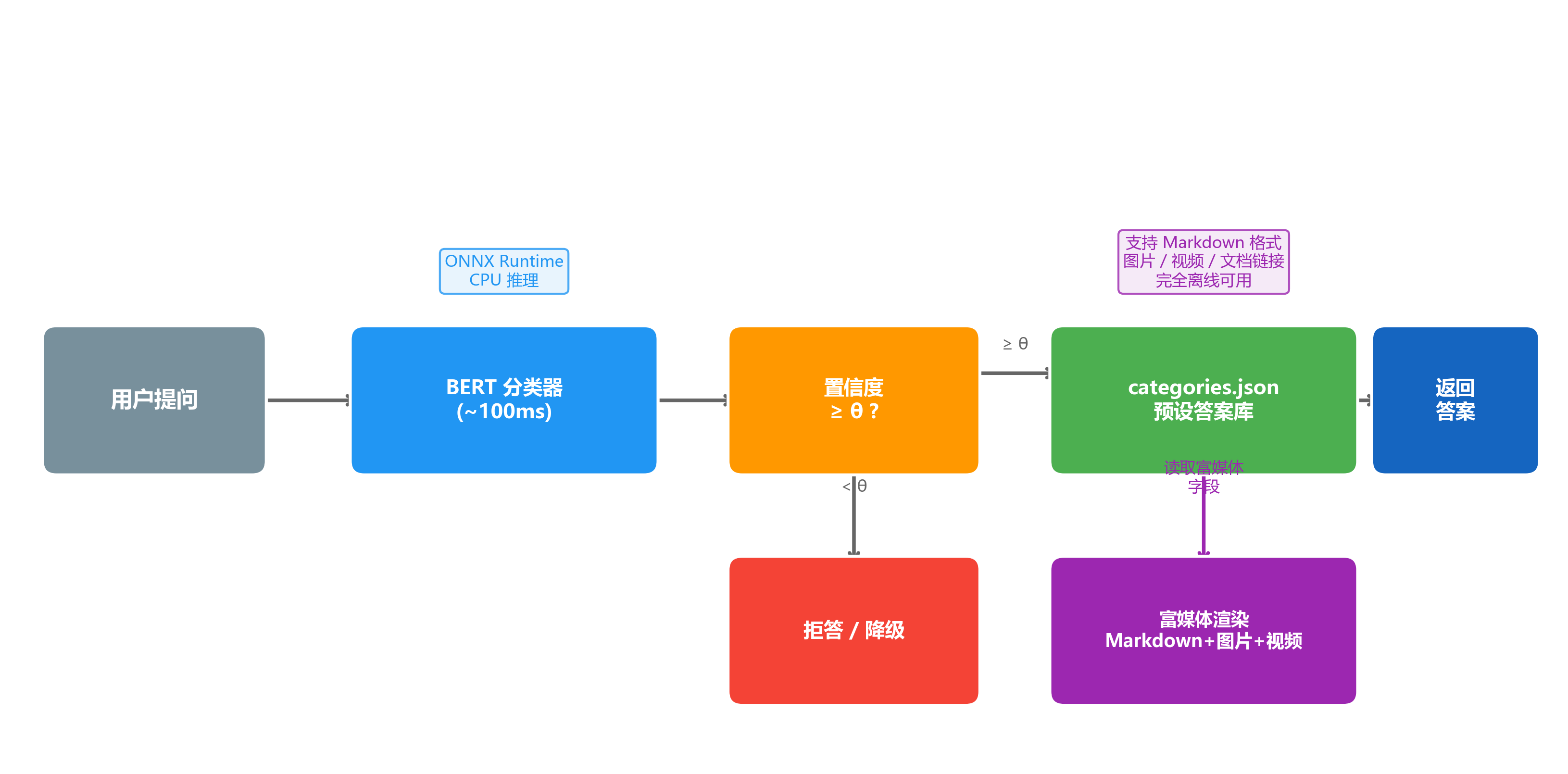
摘要:在海洋等领域数据服务与科普场景中,知识问答系统不仅面临离线运行、数据不出域、长期成本控制等部署约束,更存在一个被忽视的深层问题:生成式大语言模型(LLM)作为纯文本生成器,在架构上无法输出经过领域专家验证的富媒体内容(图片、视频、文档链接),而这类内容恰恰是领域问答的核心需求之一。本文以海洋领域知识服务为背景,从精度、延迟、成本、可离线性与体积五个维度,结合输出模态的结构性约束,系统研究了轻量理解式模型在领域问答中的适用条件。实验表明:在答案固定、边界清晰的领域封闭场景中,仅约1.02亿参数的BERT配合高质量训练数据,能够在验证集上达到96.79%的准确率,与传统方法(SVM+TF-IDF、TextCNN)精度实用等价(McNemar检验p>0.05),千亿参数级DeepSeek的零样本分类准确率(94.80%)与BERT微调后同样实用等价;而BERT在推理延迟(约100ms vs 2-5s)、成本、可离线部署等维度全面胜出。更关键的是,本文形式化地揭示了LLM的一种结构性盲区:其输出端在架构上无法实现经过验证的富媒体嵌入,而理解式方案通过预设答案天然支持这一能力。本文的核心贡献包括:(1)置信度驱动的多源知识语义去重方法;(2)系统性端侧推理性能基准;(3)传统方法与微调BERT的同数据口径对比与McNemar统计检验;(4)理解式方案的输出模态优势及其对生成式架构结构性盲区的形式化分析;(5)融合五维度定量评判与输出模态定性约束的领域QA模型选型决策流程。
关键词: BERT 领域问答 模型选型 理解式模型 输出模态 端侧部署
For information in English, please click here
Accuracy Equivalence and Output Modality Advantage of Encoder-Only Models in Domain Question Answering
Abstract:In domain-specific knowledge question answering (QA) for fields such as oceanography, systems face not only deployment constraints-offline operation, data sovereignty, and long-term cost control-but also a deeper, often overlooked problem: generative large language models (LLMs), as pure text generators, are architecturally incapable of outputting rich media content (images, videos, document links) verified by domain experts, yet such content is a core requirement of domain QA. Taking ocean-domain knowledge services as the background, this paper systematically investigates the applicability conditions of lightweight encoder-only models for domain QA from five dimensions-accuracy, latency, cost, offline capability, and model size-combined with the structural constraint of output modality. Experiments show that in closed-domain scenarios with fixed, well-bounded answers, a BERT model with only ~102 million parameters, combined with high-quality training data, achieves 96.79% accuracy on the validation set. This is practically equivalent to traditional methods (SVM+TF-IDF, TextCNN) as confirmed by McNemar\'s test (p > 0.05), and also practically equivalent to the zero-shot classification accuracy of the hundred-billion-parameter DeepSeek (94.80%). Meanwhile, BERT comprehensively outperforms LLMs in inference latency (~100 ms vs 2-5 s), cost, and offline deployability. More critically, this paper formally reveals a structural blind spot of LLMs: their output endpoints cannot, by architecture, implement verified rich media embedding, whereas encoder-only models with preset answer banks natively support this capability. The core contributions include: (1) a confidence-driven semantic deduplication method for multi-source knowledge; (2) a systematic edge-side inference performance benchmark; (3) a same-data comparison between traditional methods and fine-tuned BERT with McNemar statistical tests; (4) the output modality advantage of encoder-only models and a formal analysis of the structural blind spot in generative architectures; (5) a domain QA model selection decision framework integrating five quantitative evaluation dimensions with output modality qualitative constraints.
Keywords: BERT domain question answering model selection encoder-only model output modality edge deployment
基金:
论文图表:
引用


No.****
同行评议
勘误表
领域问答中理解式模型的精度等价性与输出模态优势
中国科技论文在线 版权所有
网站地图|
在线首页|
在线简介|
服务条款|
联系我们

京公网安备 11040202430024号 京ICP备15006316号-2| 网络出版服务许可证 (总)网出证(京)字第083号 | 文保网安备案号:1101080066
 提示


 .txt
 .ris
 .doc
评论
全部评论