
数字全息虚拟仿真系统设计与教学应用探讨
首发时间:2026-11-13
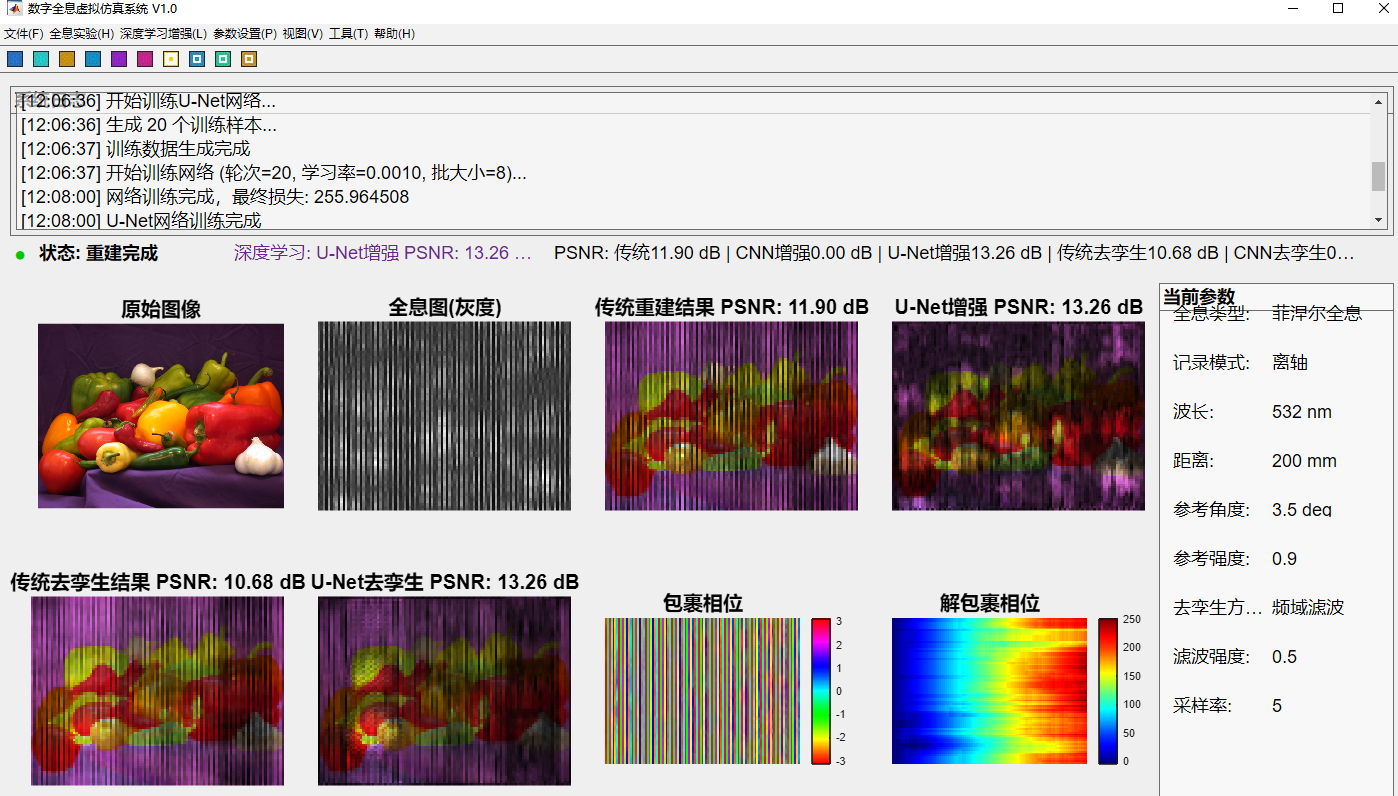
摘要:针对数字全息实验依赖激光器、光学平台与CCD相机等硬件、本科教学难以大规模开设的问题,设计并实现了一套集全息图生成、数值重建与图像增强于一体的数字全息虚拟仿真系统。系统以MATLAB为开发平台,采用用户界面层、业务逻辑层与算法核心层的分层架构,集成全息图生成、传统重建、去孪生处理、相位解包裹、深度学习增强、参数寻优、批处理与报告导出等模块,以角谱传播理论为核心实现菲涅尔、傅里叶与像面三种全息类型的数值重建,内置频域滤波、相移法与迭代算法三种去孪生方法。系统定位于教学辅助工具,不以算法指标领先为目标,而以覆盖从全息记录到图像增强的完整处理链路、提供直观的参数化交互环境为价值所在。功能验证在Windows11环境下采用512×512彩色测试图像完成,各模块运行稳定,界面响应及时。验证结果表明,该系统能够在普通教学用计算机上稳定复现数字全息的完整处理流程,为相关课程的教学演示与学生自主实验提供了可操作的虚拟仿真环境。
关键词: 光学工程 数字全息 虚拟仿真 角谱传播 深度学习增强 实验教学
For information in English, please click here
Design of a Digital Holography Virtual Simulation System and Exploration of Its Teaching Application
Abstract:Digital holography experiments rely on lasers, optical platforms and CCD cameras, which are costly to build and time-consuming to align, making it difficult to offer large-scale undergraduate laboratory courses. To address this challenge, a digital holography virtual simulation system integrating hologram generation, numerical reconstruction and image enhancement is designed and implemented. The system is developed on the MATLAB platform with a layered architecture consisting of a user interface layer, a business logic layer and an algorithm core layer. It includes functional modules for hologram generation, traditional reconstruction, twin-image suppression, phase unwrapping, deep learning enhancement, parameter optimization, batch processing and report export. Based on angular spectrum propagation theory, the system realizes numerical reconstruction of Fresnel holograms, Fourier holograms and image-plane holograms, and integrates three twin-image suppression methods: frequency-domain filtering, phase-shifting, and iterative algorithm. The system is positioned as a teaching aid, whose value lies not in pursuing leading algorithmic metrics but in covering the complete processing chain from hologram recording to image enhancement and in providing an intuitive parameterized interactive environment; the deep learning module aims to demonstrate the end-to-end learning workflow. Functional verification is carried out in a Windows 11 environment using 512×512 color test images. All functional modules run stably with timely interface response. Verification results show that the system can stably reproduce the complete digital holography processing workflow on an ordinary teaching computer, providing an operable virtual simulation environment for classroom demonstrations and independent student experiments.
Keywords: optical engineering digital holography virtual simulation angular spectrum propagation deep learning enhancement experimental teaching
基金:
论文图表:
引用


No.****
动态公开评议
共计0人参与
勘误表
数字全息虚拟仿真系统设计与教学应用探讨
中国科技论文在线 版权所有
网站地图|
在线首页|
在线简介|
服务条款|
联系我们

京公网安备 11040202430024号 京ICP备15006316号-2| 网络出版服务许可证 (总)网出证(京)字第083号 | 文保网安备案号:1101080066
 提示


 .txt
 .ris
 .doc
评论
全部评论